She had the letter ready since before dawn.
She had written it in a trembling hand, carefully keeping to the margins, as if the paper might crumble if she handled it too roughly. She folded it in three, slipped it into the envelope, and before sealing it, read the beginning one last time. Not to correct anything—only to make sure those words, so heavy, sounded as light as possible.
She was going to tell him two things: one very bad, and one very good.
The first: that his father had died the day before, without warning, with that cruel speed with which simple lives are sometimes cut short. A brief fever, a cough that didn’t seem serious, a sleepless night… and then silence, a body that no longer answered. The smell of the room still clung to her—the vinegar water, the murmur of the neighbors in the kitchen, the dry click of the rosary against a nervous hand. Her house was nothing but sorrow and crying; her mother inconsolable; the family bowed under grief.
The second: that after so long—after so much hardship—she had finally gathered the money for the ticket.
Coin by coin she had scraped it together: selling what she could, asking a little here and there, taking on jobs she had never imagined. It was no longer “someday,” but a possible date. She was going to travel. She was going to find him, even if the world was wide, even if the port smelled of wet coal and farewell tears.
That morning, though, the sky had dawned clear, as if the weather were indifferent to everything. It was early: a cool, slightly windy autumn morning.
She walked to the post office with the envelope pressed tight in the pocket of her blue wool coat. She felt her heart hammering in her throat and couldn’t tell whether it was for the death or for the other news—the one that still lit something in her chest.
The post office—across from the square—had been open only a few minutes. She pushed the door and went in. The place smelled of worn wood and fresh ink. There was no line; it was almost deserted. A few parcels wrapped in burlap sat to one side, and on the main desk a row of envelopes lay piled up, their addresses written by hand. Morning light came through the glass and drew curious shadows on the floor.
She approached the window, full of conflicting sensations.
The clerk looked up and recognized her at once. He didn’t know her name, but he knew her face: that young woman who came every week—sometimes twice—asking whether there was any news, whether anything had arrived, whether there was something “to pick up.”
“Miss…” he said, in that mix of routine and compassion learned behind a counter. “Today a letter came for you.”
She stood still, as if he had spoken a word she wasn’t expecting.
“For me?”
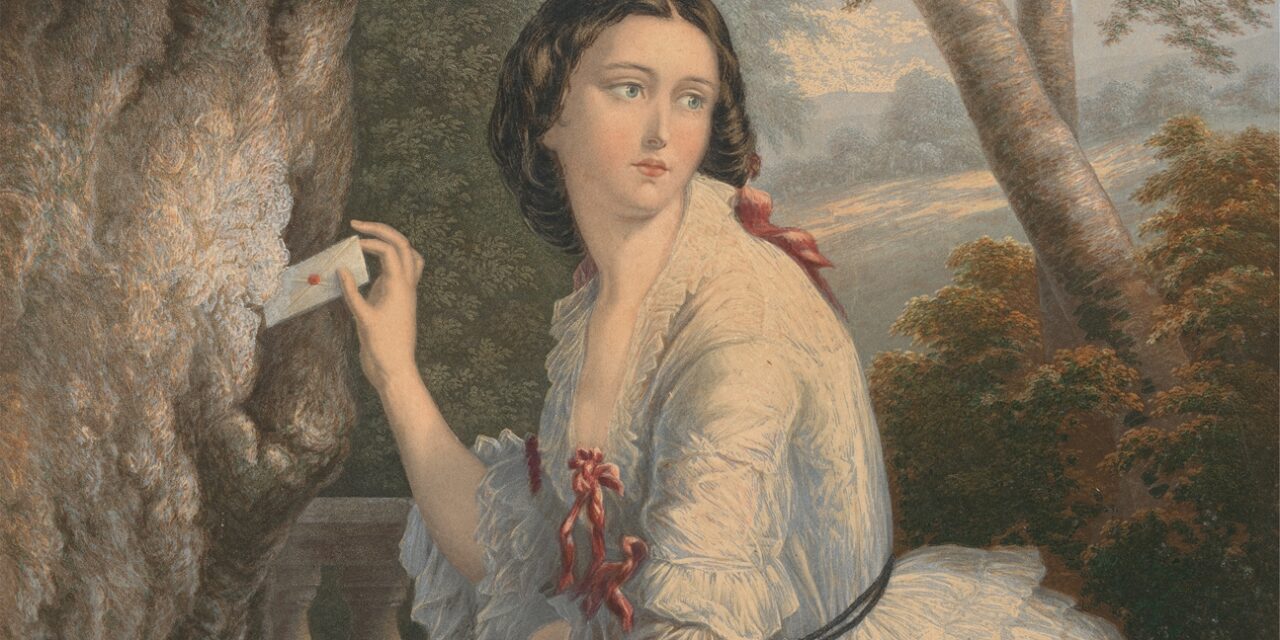
He took an envelope from a pigeonhole and slid it under the glass. She received it carefully. She recognized the handwriting at once. Luis’s handwriting.
A relief, almost childish, ran warm through her. For a second everything else—her dead father, the house in mourning, her tired hands—stayed outside, as if the world had a door that closed whenever that handwriting appeared.
The clerk glanced at the envelope in her other hand.
“Posting something?”
She hesitated, then lowered her gaze to her own envelope. The one addressed to him. The one that carried the news. The one that also carried the promise of the ticket.
“Just a moment…” she said, her voice suddenly lower. “Let me… read first.”
It wasn’t caprice. It was necessity. Somehow she needed a sign beforehand. She couldn’t send a letter like that without knowing what was coming back from the other direction, from the new life he had begun six months earlier.
She stepped away from the window and found a corner with good light. She leaned against a wall beside a sign that read MONEY ORDERS in black letters. She opened the envelope carefully, as always, trying not to tear anything that came from him, and drew out the folded sheet.
The first line stole her breath.
“Dear…”
It didn’t say her name. Only that. And yet she heard it as if he had spoken it aloud.
At first she read quickly—hungrily—her eyes leaping from one sentence to the next. Luis wrote about work, the cold, a shared room, how hard it was to get used to things. All of it was there. She expected that.
But halfway through, the tone shifted.
She felt it before she understood it: like in a conversation when someone lowers their voice and you know something is coming that cannot be ignored.
“It’s hard for me to write this. Please forgive the delay, the silence, the circles. I didn’t want to hurt you.”
The letters seemed firmer, as if he had forced himself to write every word, and each one sank into her heart like a cold blade.
“A few months ago I met someone. At first it was nothing… I thought it was only companionship in this strange place. But it became more. I have no right to hide it.”
The post office vanished. The people coming in with their letters, the murmurs, the soles on the floor—everything became a dull noise, as if she were underwater.
She kept reading because she could do nothing else.
“We’re getting married next month.”
On that line she felt something close to a physical blow, as if her chest were collapsing inward.
She had to grip the page hard to steady the shaking. Her eyes burned, but she still wasn’t crying—an incredulous, dry burning.
Luis wrote that he didn’t want to deceive her. That he wished her the best. That he hoped she would find someone who deserved her, someone who wouldn’t make her wait. That he would always remember her “with gratitude,” as if love could be stored inside a polite word. That he didn’t mean to be cruel.
“I want you to be happy,” he wrote, and the sentence felt unbearable—almost offensive—like alms.
She went back to the beginning of that part, unbelieving, reread it, searching for a crack, an error, another meaning. There was none. It was written clearly. Without margin.
Then she looked at her own envelope, still in her left hand.
In that letter was the death of Luis’s father, the day before. His father—whom he might never see again. There was the news that she had gathered the money. Her decision to travel. All of it pressed together, waiting inside an envelope that still had no stamp.
A bitter, almost absurd pang struck her: the thought that she was about to write “I’m coming” at the same time he wrote “I’m getting married.”
Luis’s page grew heavy, as if each word hid a lead weight.
She finished reading with her lips parted; breathing was difficult. At the end he signed his name as always, and that signature—that simple word—was what finally broke her.
She stood still for a second, holding the sheet in front of her face without seeing it. And then, as if her body had been waiting for final confirmation to surrender, the sob rose suddenly: first a tremor in her throat, then a sound that didn’t want to come out, and then tears—hot, disorderly—falling without permission.
She covered her mouth with her hand, but it wasn’t enough. Her shoulders shook. Behind her, the world kept working: someone argued over a money order, a woman asked for change, the clerk called the next person.
She folded Luis’s letter as best she could—carelessly now—and pressed it to her chest. The crying grew stronger, deeper, as if in that single blow she were losing everything at once: the father’s death, the months of waiting, the money gathered, the imagined ticket, the stubborn faith that love could endure and wait.
She went out into the street without knowing how. She crossed the square nearly blind. She sat alone on a bench. She slipped both letters into the right pocket of her blue coat, as if hiding them could change something.
And she cried, inconsolable, beneath a clear sky—indifferent.
Artwork by: George Baxter