Ayyan was waiting for his train to Lahore at the newly built Raiwind station, which abuts Jati Umra, the hometown of the Sharif family. An unidentified stranger, lying a few yards away from his bench in the darkness caused by the absence of electricity, was playing Madam Noor Jehan’s Payam Aye Hain on, God knows, a phone or a radio. The nippy air was thick with plumes of smoke rising from the cigarettes of passengers seated on nearby benches. Ayyan sensed the strong burning smell of tobacco and saw policemen’s flickering torchlight struggling to pierce the smoke. They were doing the rounds to ward off any unusual activity before the train’s arrival. Ayyan, averse to smoking, felt revolted with every smoke laden breath he inhaled.
Even in pitch darkness, life was in full swing. He wondered if life too followed the pattern of a railway station, always crowded with people, yet without a single soul you could call your own. As he was immersed in these thoughts, Noor Jehan poured her heart into every note, and her emotive voice, rising and falling, struck him deeply. His mood was already mellow and the song, owing to its evocative lyrics, made it even mellower. It seemed to be playing on a loop. There was no end to the melancholic voice nor to the feelings swelling in Ayyan’s heart.
The wintry season is generally a delight for summer scorched people of this part of the world. Many flaneurs roam the roads to soak in the vibe of Lahore’s rich culture and vibrant ambience. But as soon as the dense foggy spell, beginning in early December and lasting till mid February, sets in, traffic decreases manifold. When the night is well advanced, only a handful of adventurous people risk driving their own vehicles. The rest prefer to travel by train. Ayyan was indeed a flaneur and part of the latter clan. Hence, he found himself seated at the station among strangers.
The sky and stars were invisible due to fog and near zero visibility. Consequently, trains were running far behind schedule. In the meantime, gusts of fog struck the faces and exposed bodies of the passengers. Everyone’s eyes, or rather their heads, as Ayyan observed their napes in the dim light, particularly those of the elderly, were turned towards the direction from which the train was expected. Ayyan sat calmly reading Train to Pakistan by Khushwant Singh in the light of his smartphone. The light was just enough to let him make the most of the time.. After reading the line, “O letter, let my lover learn how the fires of separation burn,” he was beside himself with joy, drowned in the beauty of words and thoughts of his innamorata. There and then, he longed to jot down a letter to her and send it at the speed of a Concorde.
Soon, the rush increased, and the fidgeting footsteps of a grey-haired, frail-looking woman wrapped in a beige coloured shawl broke his reverie. She was about the age of his grandmother and was cursing the authorities, not because the train was late, but because there was no place for her to shield herself from the merciless cold. In a trembling voice, she asked Ayyan, “O putar, aye train kiddon aani ae? Zara apne phone te dekh ta sahi. Meriyan haddiyan tharr gayian ne, te aithe ik vi kamra nai jithe sade varga banda baith sake. Eh andar baithe ne te saanu Rab de hawale kita hoya ae.” (O son, when will this train arrive? Please check it on your phone. My bones have frozen and there is not a single room where someone like us can sit. They(employees) are sitting inside while we have been left at God’s mercy.)
A person sitting beside Ayyan checked the train tracker and informed her that the estimated arrival time was 7:42 pm. She stayed silent for a few seconds and then said the train would not arrive before 8:30. “I speak from experience,” she added. She remarked that apart from three or four trains, none was ever on time. “Such is the state of Pakistan Railways,” she said regretfully.
Ayyan heard the woman, but his mind was occupied with thoughts of the girl he was once head over heels in love with. For the first time, a spark of affection and longing stirred within his adolescent heart. Over the past few months, he had begun to love life with unusual seriousness. He found beauty and joy in the simplest occurrences of everyday life. Flowers such as bougainvilleas, gulmohar, lilies, chrysanthemums and frangipani, of which he had been oblivious until recently, now caught his attention. He touched their petals with care and wished to be in their company whenever he could. He was living the best days of his life, untroubled by whatever the future might hold for him. He had not yet earned a penny, neither for himself nor for his family. As he drifted through these rosy reflections, he heard the shrill whistle of the train approaching Platform No. 1.
Soon, the train pulled into the station. It was difficult to know where the train of Ayyan’s thoughts would carry him. But the one before him would take him to the city he loved most, the city where he was born, where he lived and loved, and where he learned to cherish even the most ordinary days. The city whose people and architecture he had fallen in love with, whose nights and days he cherished alike. Yes, this train would take him to Lahore.
(The Punjabi lines spoken by the woman have been translated by the author.)
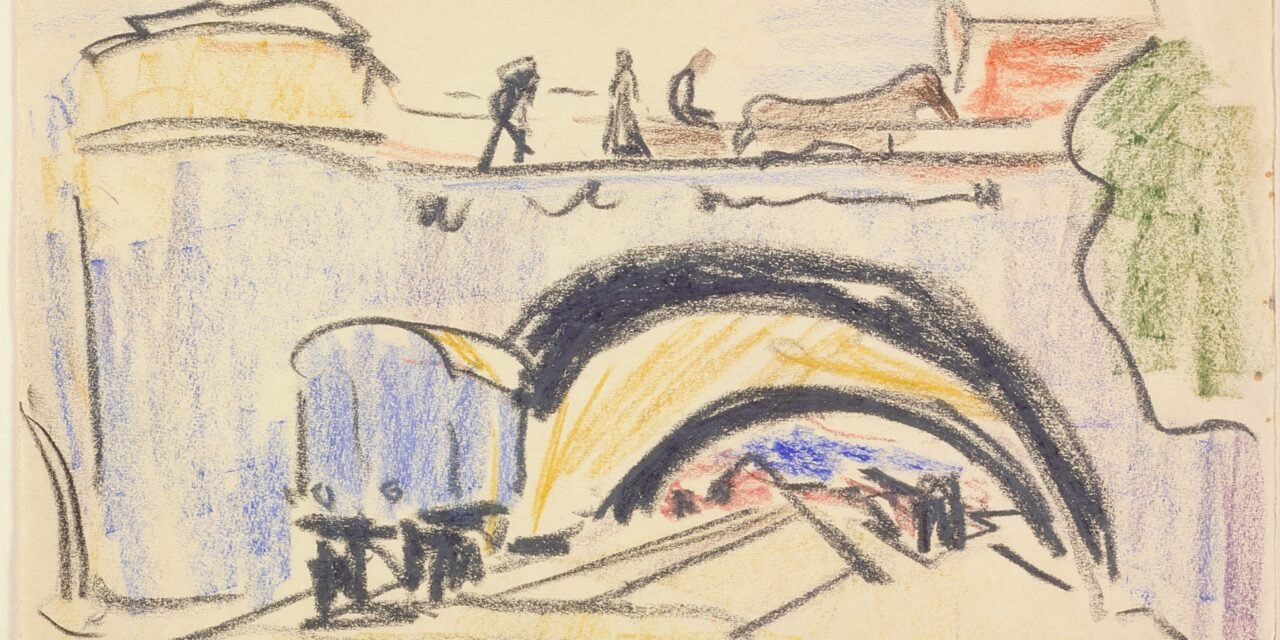
Artwork by: Ernst Ludwig Kirchner